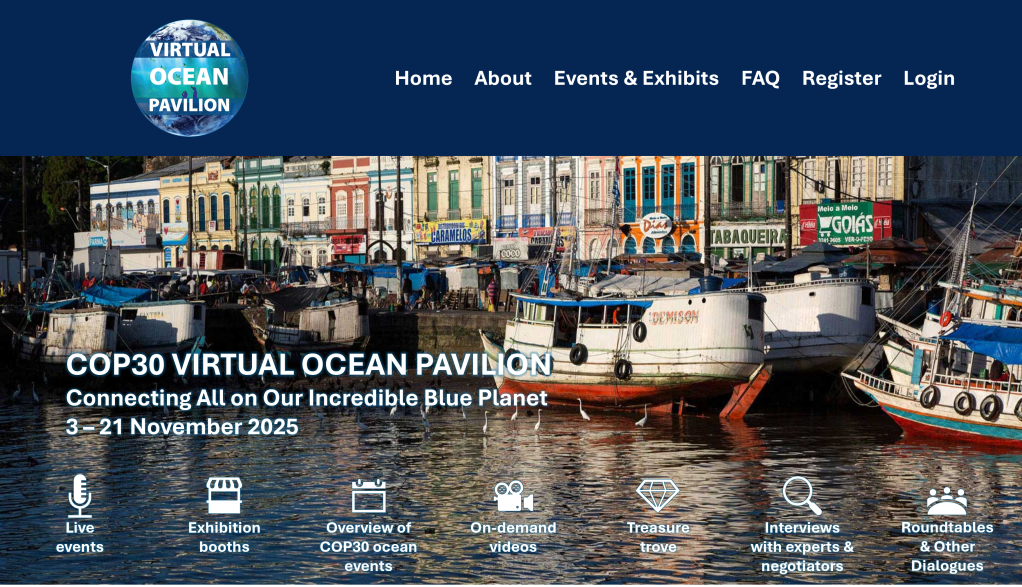
The fifth annual Virtual Ocean Pavilion (VOP) will be held from 3 to 21 November 2025, opening ahead of the 30th session of the Conference of the Parties to the United Nations Framework Convention on Climate Change (UNFCCC COP30, 10 to 21 November 2025) and lasting for its duration. The Global Ocean Forum (GOF) and Plymouth Marine Laboratory (PML) will return as co-organizers and are pleased to welcome Ocean Generation to the COP30 Virtual Ocean Pavilion co-organizing team.
Pavilion Aims
Building on the momentum of past Virtual Ocean Pavilions (COP26, COP27, COP28, and COP29) the COP30 Virtual Ocean Pavilion will:
Continue to raise the profile of the ocean among members of the ocean and climate community and the public;
Provide a communication platform for those who are unable to participate in COP30 in person from various parts of the world;
Address COP30 priorities while promoting the incorporation of the ocean into UNFCCC processes; and
Encourage cross-sectoral cooperation and collaboration on ocean-climate action at the national, regional, and global levels.
In addition to the traditional Pavilion aims, this year’s COP30 Virtual Ocean Pavilion will also highlight the following focal areas:
National and regional action focusing on the ratification of the Agreement on Marine Biological Diversity of Areas beyond National Jurisdiction (BBNJ Agreement) and the opportunities it provides to explore the mitigation and adaptation potential of marine areas beyond national jurisdiction (ABNJ); and
The outcomes of the third UN Ocean Conference (UNOC), including those that call for leveraging ocean, climate, and biodiversity interlinkages.
Participation
Registration will be available following the launch of the COP30 Virtual Ocean Pavilion landing page on 10 June at 10:00 CEST. As always, registration is free and open to all. Attendees will have online access to live ocean events from 3 to 21 November and on-demand content from 22 November to 22 December. All you will need is a Wi-Fi connection and a smart phone, tablet, or computer. Following each live event, on-demand event recordings will be available throughout the duration of the COP30 Virtual Ocean Pavilion.
Pavilion Features
Key Messages
Key messages emanating from the COP30 Presidency, High-Level Climate Change Champions, Ocean Breakthroughs and other Marrakech Partnership for Global Climate Action (MPGCA) initiatives, the 2025 Ocean and Climate Change Dialogue, and the third UN Ocean Conference (UNOC) will be formulated and promoted through the Virtual Ocean Pavilion. Communications Inc and collaborating partners of the COP30 Virtual Ocean Pavilion will be leading the crafting of these messages, which will be the focus of live events and roundtables. All attendees are encouraged to review, reflect, and react to the COP30 Virtual Ocean Pavilion key messages. Continued dialogue among attendees and partners and sharing of the messaging with wider audiences is welcome.
Live Events
The COP30 Virtual Ocean Pavilion will once again offer a series of live events featuring eminent high level speakers from national and regional organizations, intergovernmental organization representatives, ocean and climate experts, and youth leaders from around the world. The events will address the Pavilion aims through dialogues incorporating science, finance, partnership and capacity building, public education, and collaboration with a focus on strengthening ocean and climate action as well as securing a place for the ocean in the climate negotiations.
The 2024-2025 Report on Assessing Progress on Ocean and Climate Action (ROCA Report) will be launched during a 90-minute live event during the COP30 Virtual Ocean Pavilion. This biennial report provides an assessment of ocean and climate science, policy, and action through contributions of over 5o co-authors from organizations around the world. A new addition to this volume will be a section on ocean-based solutions to mitigation and adaptation issues successfully adopted and reported within the years covered by the report.
Exhibits
Diverse and wide-ranging exhibits organized by leading ocean and climate organizations to showcase new and ongoing ocean-climate-biodiversity initiatives will be featured in the COP30 Virtual Ocean Pavilion Exhibit Hall. The exhibition booths will showcase ocean and climate activities and resources of collaborating partners and sponsors. The booths will also provide access to information that attendees can ‘take away’ in virtual delegate bags as well as venues for informal meetings with experts and networking among exhibit hosts and attendees.
Roundtable Discussions
After a successful launch during the COP29 Virtual Ocean Pavilion, roundtable discussions are returning for the COP30 Virtual Ocean Pavilion. Roundtable discussions will be held during the live days of the Pavilion and will provide smaller, more intimate spaces where ideas on how to promote the key messages and address other ocean-climate-biodiversity themes will be equally exchanged by participants.
COP30 Ocean Events Tracker
The Pavilion will offer a gateway to COP30 ocean-related events through the COP30 Ocean Events Tracker. Information gathered through the tracker will be incorporated into a calendar of ocean events accessible through the Virtual Ocean Pavilion Lobby. In addition, the Virtual Ocean Pavilion team will review programs of COP30 Pavilions and solicit input from collaborating partners to showcase as many ocean-related events during the COP as possible.
Treasure Trove
The Treasure Trove is prepared daily by the Pavilion secretariat and includes the latest updates on ocean and climate happenings in and around COP30. Peruse this valuable resource to find spotlights on our interactive exhibit booths, highlights of upcoming Pavilion and COP30 events, stories from the sea, trivia, and other exciting highlights from this year’s COP.
How to Get Involved
A Call for Collaborating Partners
The Virtual Ocean Pavilion would not be possible without the support of its many collaborating partners. The COP30 Virtual Ocean Pavilion Co-organizers invite Expressions of Interest for the organization of live events, exhibits, roundtable discussions, and sponsorships. Expressions of Interest are due by 15 September 2025 and should be submitted to Miriam Balgos (mbalgos@globaloceanforum.com) and Thecla Keizer (tke@pml.ac.uk). Early submissions are encouraged.
Support the COP30 Virtual Ocean Pavilion
The Virtual Ocean Pavilion is organized through a volunteer effort facilitated by a dedicated team of co-organizers and collaborating partners. Contributions and donations to support the organization of the Pavilion are always welcome. Please consider donating here.
Contact the COP30 Virtual Ocean Pavilion Team
For more information on this year’s COP30 Virtual Ocean Pavilion and how to get involved, contact the Virtual Ocean Pavilion Team:
For more information on past Virtual Ocean Pavilions, see the COP26, COP27, COP28, and COP29 Virtual Ocean Pavilion web pages, or view their summary reports, available here.
Moments from past Virtual Ocean Pavilions
The Virtual Ocean Pavilion was launched during the UNFCCC COP26 (held in Glasgow, 31 October – 12 November 2021). A second was organized during COP27 (held in Sharm El Sheik, 6 – 18 November 2022), a third was organized at COP28 (held in Dubai, 30 November – 12 December 2023), and a fourth was organized at COP29 (held in Baku, Azerbaijan 11 – 22 November 2024).
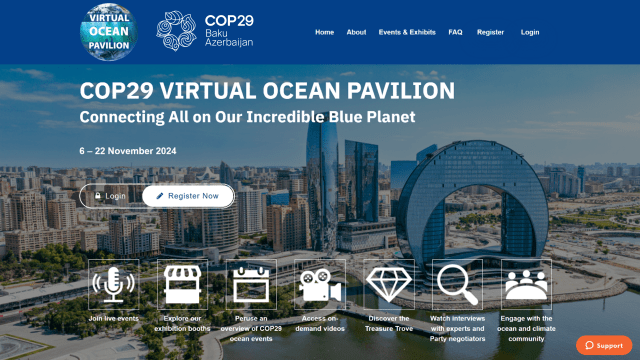
The fourth annual Virtual Ocean Pavilion (VOP) was held from 6 – 22 November 2024 opening ahead of the 29th session of the Conference of the Parties to the United Nations Framework Convention on Climate Change (UNFCCC COP29, 11 – 22 November 2024) and lasting for its duration. With the overall coordination by the Global Ocean Forum (GOF) in close partnership with the Plymouth Marine Laboratory (PML), it was co-organized by the GOF and PML together with 19 collaborating partners.
The Virtual Ocean Pavilion is an online platform dedicated to raising the visibility of the ocean and showcasing why the ocean matters in climate negotiations and to all life on our planet. With the COP29 pavilion, the organizers and sponsors continued to encourage a wide range of involvement to reach those that cannot attend COP29 in-person. These efforts provided access to a long-lasting resource for all, democratizing access to the ocean at COPs while increasing knowledge – leaving no one behind.
In addition to the COP29 priorities, the Virtual Ocean Pavilion addressed the opportunity presented by the new Agreement on Marine Biodiversity of Areas beyond National Jurisdiction to leverage the ocean-climate-biodiversity nexus and accelerate the implementation of ocean-climate action. It will also focused on the 2025 United Nations Ocean Conference (UNOC) ocean action panel themes, which aims to accelerate action and mobilize all actors to conserve and sustainably use the ocean by supporting the implementation of Sustainable Development Goal 14 (SDG14).
The Pavilion for COP29 enabled engagement with and visibility of ocean-related issues to augment the in-person COP experience through interactive features. Some of these features included:
A wide variety of exhibits, including booths showcasing national and international initiatives on ocean and climate;
Multiple opportunities for networking and developing synergies among attendees;
Educational resources shared through virtual exhibit booths, Treasure Trove, and other areas throughout the virtual platform;
A gateway to ocean and climate stories from around the world; and
Links to other ocean events at and around the COP.
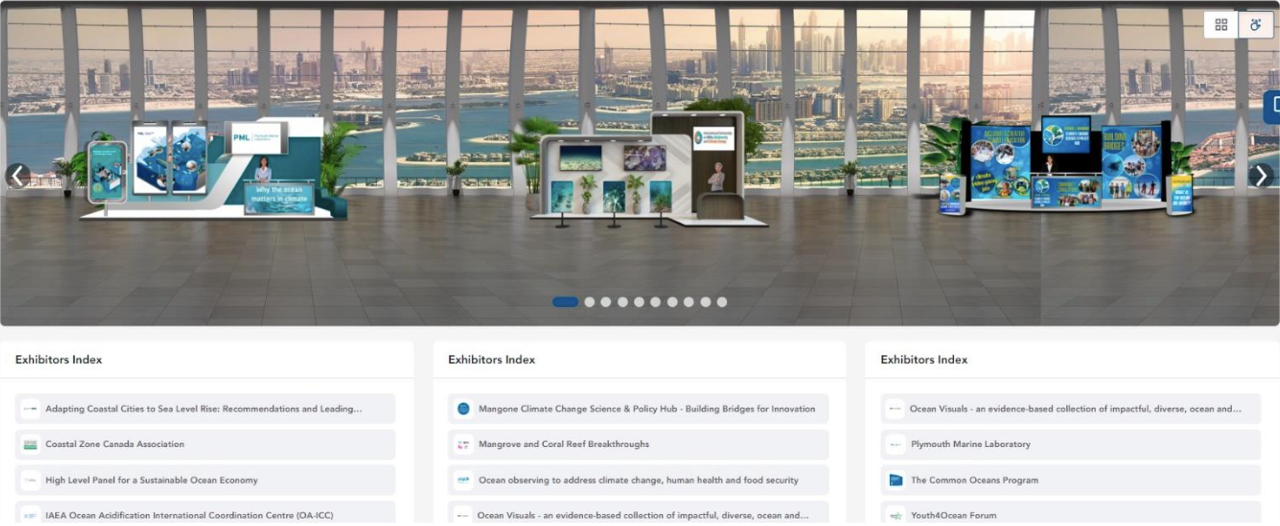
The Lobby of the UNFCCC COP29 Virtual Ocean Pavilion
Pavilion Features
Live Events
Nine live events were conducted during the COP29 VOP, which featured eminent high level speakers from national and regional organizations, intergovernmental organization representatives, ocean and climate experts, and youth leaders from around the world. The events addressed science, finance, partnership and capacity building, public education, collaboration and coordination with a focus on strengthening ocean and climate action as well as securing a place for the ocean in the climate negotiations. Visit the Global Ocean Forum’s YouTube Channel to watch recordings of the live events.
Eleven diverse and wide-ranging exhibits organized by leading ocean and climate organizations to showcase new and ongoing ocean-climate-biodiversity initiatives were featured in the COP29 Virtual Ocean Pavilion Exhibit Hall. The 11 exhibition booths were used by collaborating partners and sponsors to showcase their activities and resources on ocean and climate action. The booths provided access to information that attendees were able ‘take away’ in their virtual delegate bags as well as venues for informal meetings with experts and networking among exhibit hosts and attendees.
The Pavilion became a gateway to COP29 ocean-related events through the COP29 Ocean Events Tracker, which was organized by the Global Ocean Forum and the Plymouth Marine Laboratory. Information gathered through the tracker was incorporated into a calendar of ocean events accessible through the Virtual Ocean Pavilion Lobby. In addition, the Virtual Ocean Pavilion team reviewed programs of COP29 Pavilions and solicited input from collaborating partners to showcase as many ocean-related events during the COP as possible. There were approximately 170 ocean-related events included in the COP29 compilation.
Treasure Trove
The Treasure Trove is prepared daily by the Pavilion secretariat and includes the latest updates on ocean and climate happenings in and around COP29. Peruse this valuable resource to find spotlights on our interactive exhibit booths, highlights of upcoming Pavilion and COP29 events, stories from the sea, trivia, and other exciting highlights from this year’s COP.
A pre-final summary report on the COP29 Virtual Ocean Pavilion is available here. A final report will be shared once the post-event survey is finalized.
Summaries of select roundtable discussions drafted in collaboration with roundtable participants and speakers are included below.
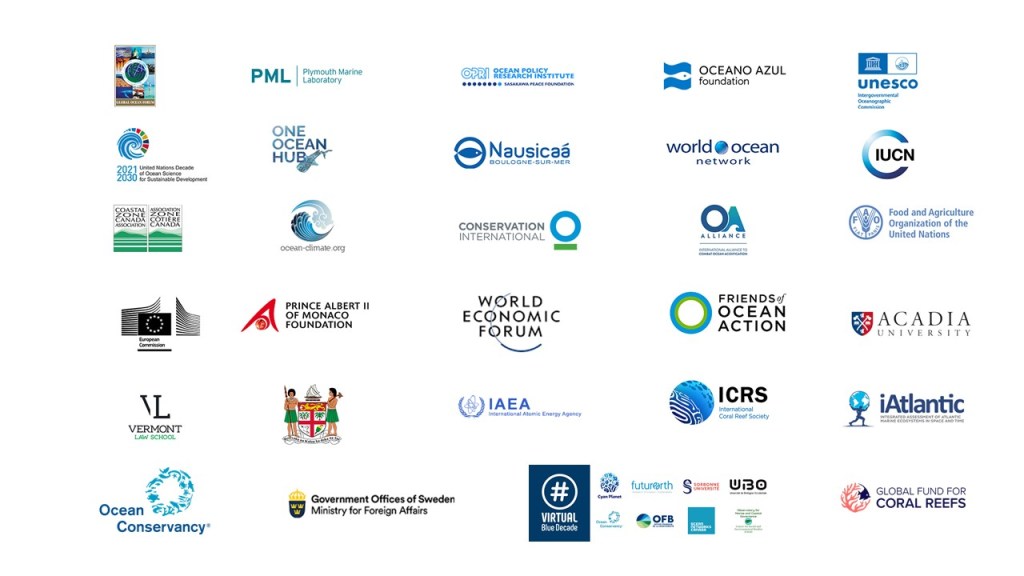
The Virtual Ocean Pavilion would not be possible without the support of its many collaborating partners. This year’s Virtual Ocean Pavilion is supported by the following organizations:
Follow the links above to learn more about the many initiatives undertaken by the COP29 Virtual Ocean Pavilion collaborating partners to raise the visibility of the ocean and showcase why the ocean matters in climate negotiations and to all life on our planet. Details on how to get involved and support the COP29 Virtual Ocean Pavilion are included below.
How to Get Involved
Contact Miriam Balgos (mbalgos@globaloceanforum.com), Catie Mitchell (cmitchell@globaloceanforum.com), and Thecla Keizer (tke@pml.ac.uk) to get involved with future iterations of the Virtual Ocean Pavilion. Contributions and donations to support the organization of the Pavilion are always welcome. Please consider donating here.
For more information on past Virtual Ocean Pavilions, see the COP26, COP27 and COP28 Virtual Ocean Pavilion web pages, or view their summary reports, available here.
Moments from past Virtual Ocean Pavilions
The Virtual Ocean Pavilion was launched during the UNFCCC COP26 (held in Glasgow, 31 October – 12 November 2021). A second was organized during COP27 (held in Sharm El Sheik, 6 – 18 November 2022), and a third was organized at COP28 (held in Dubai, 30 November – 12 December 2023).
The third ever Virtual Ocean Pavilion (VOP) was held from November 22 until December 12, 2023, opening ahead of the 28th session of the Conference of the Parties to the United Nations Framework Convention on Climate Change (UNFCCC COP28, 30 November – 12 December 2023) and lasting for its duration. With the overall coordination by the Global Ocean Forum (GOF) in close partnership with the Plymouth Marine Laboratory (PML), it was co-organized by the GOF and PML together with 15 collaborating partners.
The virtual pavilion environment was designed to mimic a physical event hall with a lobby featuring ocean graphics where participants could navigate the platform and access features including the COP28 Ocean Events Tracker, Treasure Trove, Pavilion Agenda, info desk, a Pavilion quiz, youth-led Interviews, an exhibit hall housing 12 exhibition booths; and an auditorium where visitors could attend webinars in person or view webinar recordings on demand. The Pavilion drew 1,265 registrations, representing 112 countries, of which 605 (48%) logged in to visit the Pavilion and participate in its various features within the duration of the Pavilion (22 November – 12 December 2023, including a post-event hosting period from 12 December 2023 – 12 January 2024).
ABOUT THE COP28 VIRTUAL OCEAN PAVILION
The COP28 Virtual Ocean Pavilion was an online platform dedicated to raising the visibility of the ocean and showcasing why the ocean matters in climate negotiations and to all life on our planet. It aimed to increase knowledge, commitment, and action for the ocean-climate nexus during and at key events in the run up to the UN Climate Conference (COP28) by providing an accessible and climate-friendly option for participation and engagement.
Highlight 1: Registrants from over 100 countries engaged with the COP28 Virtual Ocean Pavilion and collaborating partners included intergovernmental organizations, non-profit organizations, governments and academic institutions. A diverse range of both collaborating partners and attendees is something strived for by the Pavilion organizers and we are pleased to say that COP28’s VOP delivered.
Highlight 2: The COP28 Virtual Ocean Pavilion provided a climate-friendly alternative to attending COP28 in-person. As concerns for the climate grow, it is important that low-carbon options such at the Virtual Ocean Pavilion are made available not only to democratize who can participate in UNFCCC processes but also to provide an alternative for those who wish or plan to participate but do not want to increase their carbon footprint by doing so. The COP28 VOP is proud to say that through its virtual platform, substantial carbon emissions were saved.
PAVILION FEATURES
Live Events
Eight live events were conducted during COP28 under the Pavilion, which featured eminent high level speakers from national and regional organizations, intergovernmental organization representatives, ocean and climate experts, and youth leaders from around the world. The events, which were conducted as webinars, addressed science, finance, partnership and capacity building, public education, collaboration and coordination with a focus on strengthening ocean and climate action as well as securing a place for the ocean in the climate negotiations. Visit the Global Ocean Forum’s YouTube Channel or click on any of the links below to watch recordings of the live events. For more information on the live events, read the COP28 Virtual Ocean Pavilion Summary Report.
To begin the series of live events hosted by the Pavilion, co-organizers Global Ocean Forum and Plymouth Marine Laboratory launched the COP28 Virtual Ocean Pavilion Preview Event, titled Showcasing the Ocean at COP28, on 22 November 2023. The event focused on what was to come for the ocean community at COP28, providing a preview of the COP28 Virtual Ocean Pavilion and of ocean events at COP28 more generally. The event also discussed the key findings and recommendations for Parties and Non-Party Stakeholders from the launch of the ‘Assessing Progress on Ocean and Climate Action 2022-2023’ report and included speakers from GOF, PML, Ocean Conservancy, Ocean & Climate Platform, World Maritime University and the United Nations.
Designed to coincide with the opening of COP28 itself, the next two events in the Virtual Ocean Pavilion series occurred on 30 November 2023. The two events were titled COP28 Virtual Ocean Pavilion Opening Event: Integrating Ocean and Climate Action and Shifting Goals: What is the Ocean We Want, and were organized by Global Ocean Forum and Plymouth Marine Laboratory and the Gerard J. Mangone Climate Change Science and Policy Hub, respectively. The events focused on providing the argument and rationale for increasing coordination and collaboration among ocean-climate initiatives through integrated and ecosystem-based approaches and highlighted social science advances in identifying ocean goals, coordinating, negotiating, and implementing them, even as they change over time and scale, respectively.
Next in the series of events were three events held on 8 December 2023. These events were titled Connecting Generations for Ocean and Climate Action: An Online Workshop, Advancing the Coral and Mangrove Breakthroughs and Marine Protected Areas (MPAs) Role in Meeting Climate Change Goals: Investigating and Protecting Blue Carbon in MPAs.
The purpose of the online workshop, organized by Nausicaa, Youth and Environment Europe and the Youth4Ocean Forum, was to draw young people and senior professionals together to identify and prioritize key challenges relating to the ocean and climate change in diverse geographical regions of the world, generate and prioritize individual and collective actions and concrete solutions that can be taken up by individuals of all ages either on their own or as a community. These key challenges and concrete action solutions will be assembled in a digital networking tool that will help build an ocean virtual community of practice in response to different thematic challenges that the ocean and climate topic is part of. The digital tool will be relevant throughout the world and free of charge and will be presented at the United Nations Ocean Conference scheduled in June 2025 in France.
In the live event titled Advancing the Mangrove and Coral Reef Breakthroughs, the Global Fund for Coral Reefs (GFCR), the Global Mangrove Alliance (GMA), the International Coral Reef Initiative (ICRI), the United Nations Environment Programme (UNEP), the United Nations Development Programme (UNDP), and the High-Level Climate Champions (HLCC) presented the Coral Reef Breakthrough and the Mangrove Breakthrough agendas. The Coral Reef Breakthrough and Mangrove Breakthrough, as part of the 2030 Breakthroughs Agenda, aim to mobilize action to halt loss, restore, protect, and ensure sustainable finance for these threatened and valuable ecosystems. The event featured state representatives, Climate Champions, and globally renowned scientists to hold panel discussions on key issues related to coral reef and mangrove conservation and restoration in order to accelerate awareness of the Breakthroughs and promote climate action.
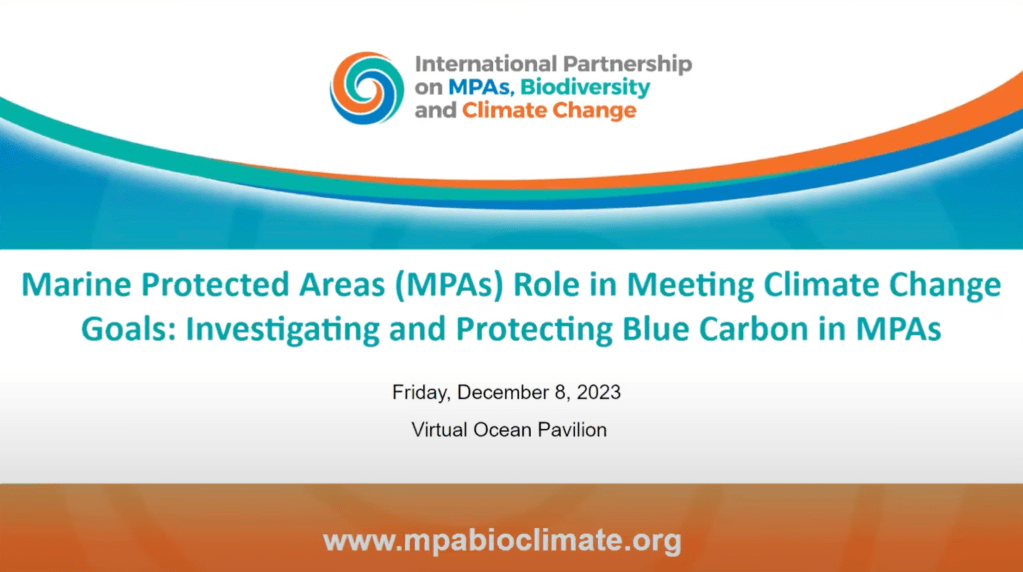
Promotional flyer from COP28
The third event held on 8 December, Marine Protected Areas (MPAs) Role in Meeting Climate Change Goals: Investigating and Protecting Blue Carbon in MPAs, provided evidence to national and international policy makers on the role MPAs can play to conserve biodiversity, mitigate climate change, and to adapt to climate change in order to inform and promote the role of MPAs as nature-based solutions to meet Nationally Determined Contributions. This session shared methodologies to assess blue carbon habitats, blue carbon habitat restoration case studies, and methodologies to understand existing protection and potential gaps and was organized by the International Partnership on MPAs, Biodiversity and Climate Change.
To conclude the live events hosted by the COP28 Virtual Ocean Pavilion, two events were held on the last day of COP28, 12 December 2023. The first event was titled Managing and Protecting Ocean Spaces for Climate, Biodiversity and People by 2030 and was hosted by World Maritime University. This event discussed the challenges and opportunities for marine protected areas and marine spatial planning to address the biodiversity and climate crises, the role of ocean carbon in the Global Stocktake, and implications for science, policy, management, and capacity building.
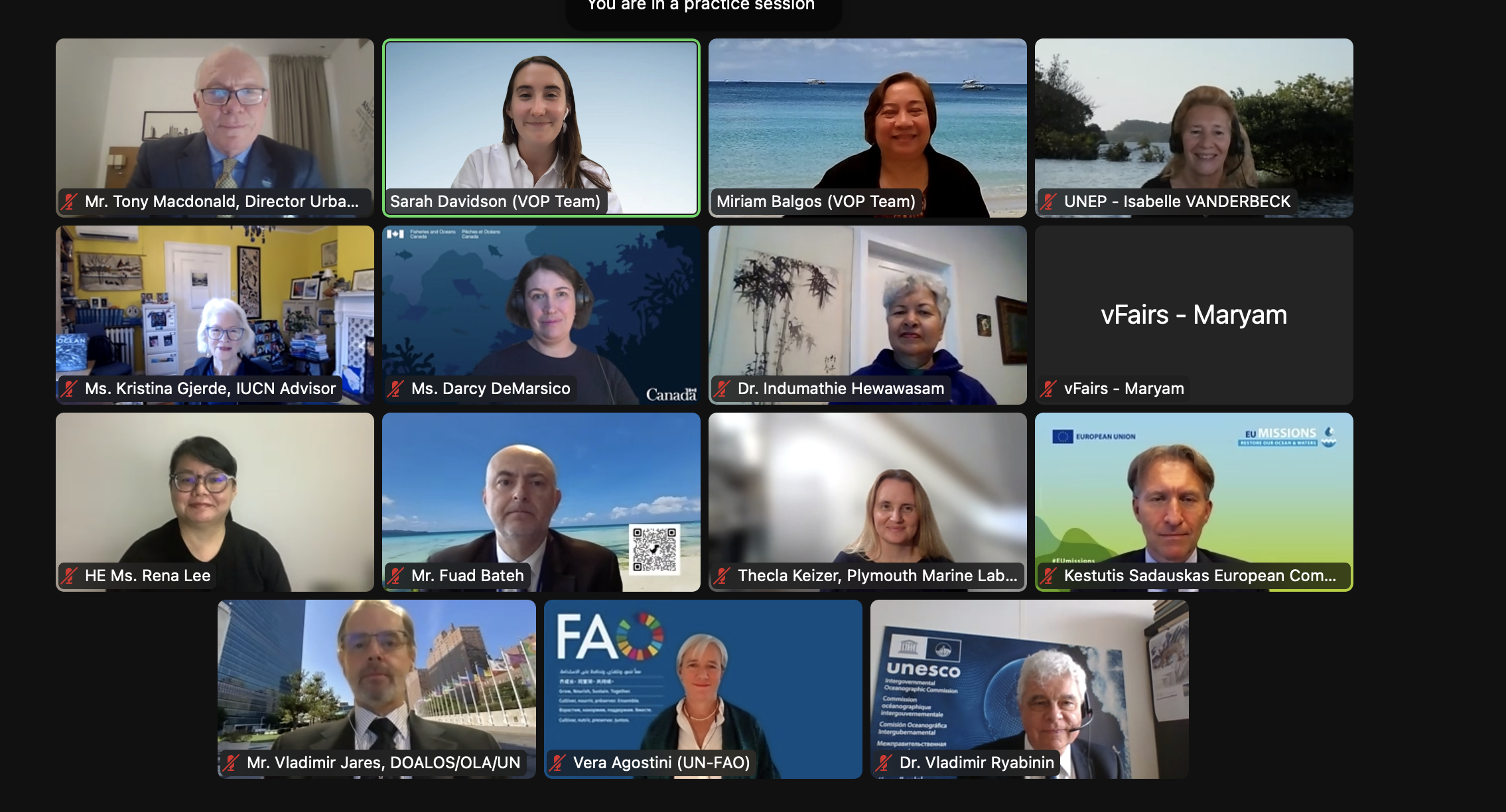
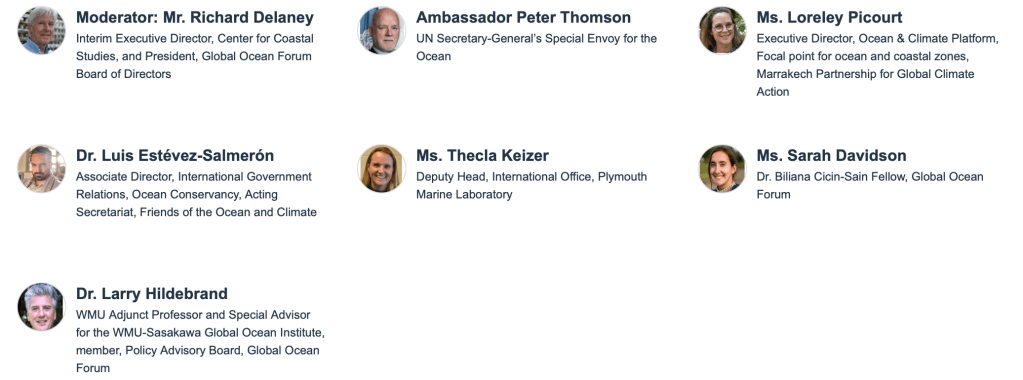
The second event held on 12 December and the final event in the Virtual Ocean Pavilion series was titled COP28 Virtual Ocean Pavilion Closing Event: Climate Change and the BBNJ Agreement was co-organized by Global Ocean Forum and Plymouth Marine Laboratory. This high level event discussed the collaborative and cooperative approaches that are being used to progress the ocean in the climate, biodiversity, and sustainable development agendas. This event capped a series of live events organized by the Global Ocean Forum and Plymouth Marine Laboratory which focus on the theme “Integrating Ocean and Climate Action” and underscored the opportunity provided by the adoption of the new BBNJ Agreement in June 2023 and its signing by over 80 countries in September 2023 to explore the mitigation and adaptation potential of the vast high seas, along with its ecosystems and resources. The event included high-level interventions, personal experiences and messages across the age spectrum and gave examples of collaborative undertakings at various levels that may be applicable to the ABNJ as well as discussing next steps as countries begin to ratify and implement the BBNJ agreement. The session concluded with a review of the role and accomplishment of the COP28 Virtual Ocean Pavilion in engaging and reaching out to those not able to attend COP28 in person, indeed in its role of democratizing the ocean at COP28 and promoting unity and inclusivity.
Speakers at the COP28 Virtual Ocean Pavilion Closing Event: Climate Change and the BBNJ Agreement
Exhibits
Twelve diverse and wide-ranging exhibits were featured in the COP28 Virtual Ocean Pavilion exhibit hall and were a main draw to this year’s Pavilion. The 12 exhibition booths were used by collaborating partners and sponsors to showcase their activities and resources on ocean and climate action. The booths provided access to information that attendees were able ‘take away’ in their virtual delegate bags as well as venues for informal meetings with experts and networking among exhibit hosts and attendees. For more information about the booths, click on the booth titles below or read the COP28 Virtual Ocean Pavilion Summary Report.
The Pavilion became a gateway to COP28 ocean-related events through the COP28 Ocean Events Tracker which was organized by the Global Ocean Forum and the Plymouth Marine Laboratory in collaboration with virtual platform provider vFAIRS. Pavilion attendees were invited to register their events through a tracker form. The entries then became part of a calendar of COP28 ocean events accessible through the Virtual Ocean Pavilion and based on information gathered through the tracker, by the Virtual Ocean Pavilion team and by various other organizations that conducted their respective programs of ocean-related events during the COP. There were over 300 unique ocean-related events included in the COP28 compilation, showing an increase of approx. 100 events when compared to the COP27 Virtual Ocean Pavilion Ocean Events feature.
Treasure Trove
The COP28 Virtual Ocean Pavilion Treasure Trove was a resource updated daily which highlighted a collection of presentations, ocean videos, art and photos, ocean and climate stories, reports, and other publications from around the world.
Highlights from the Treasure Trove included daily updates from COP28, spotlight features of Virtual Ocean Pavilion exhibit booths, original art generated by questions posed to VOP registrants, a review of the final COP28 agreement and notable outcomes, and other news from across the ocean-climate nexus.
Quiz
This year’s Pavilion included a Pavilion Quiz as a new feature, designed to increase engagement and allow attendees to earn a certificate. The quiz included questions specific to the COP28 Virtual Ocean Pavilion, as well as questions about COP28 and the ocean-climate nexus more broadly.
Youth-led Interviews
To provide a platform for the younger generation to get involved in ocean and climate negotiations, the COP28 Virtual Ocean Pavilion partnered with several youth-focused organizations to connect with individuals interested in conducting interviews over the course of COP28. The aim of the interviews was to allow Virtual Ocean Pavilion attendees to gain insights about COP28 from Party negotiators and key stakeholders while also creating opportunities for involvement for interested youth and early career ocean professionals. Interviews from the COP28 Pavilion as well as from past Pavilions are available on the Global Ocean Forum’s YouTube channel.
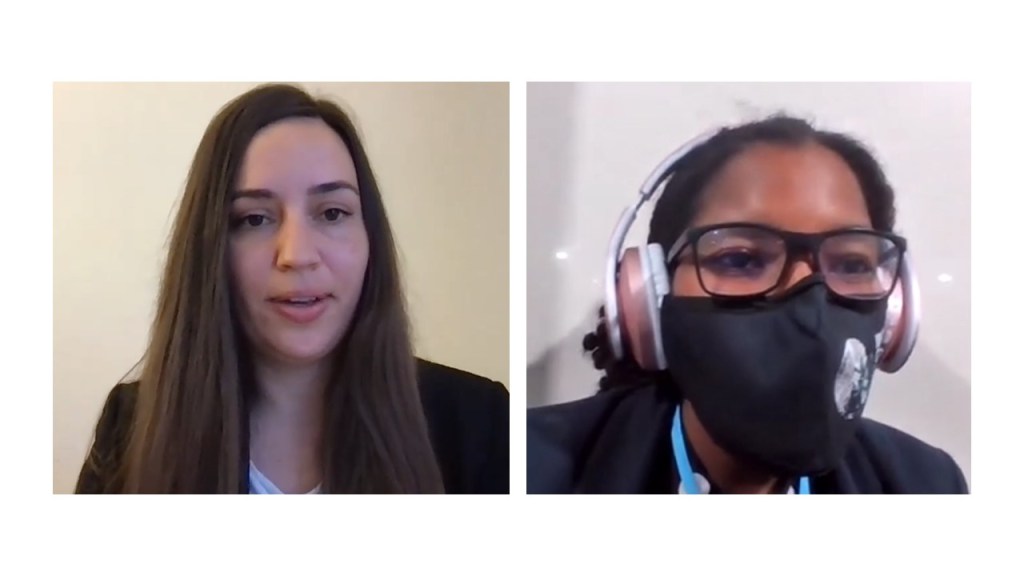
Maria Brown, Superintendent of Greater Farallones and Cordell Bank National Marine Sanctuaries, NOAA, being interviewed by Emma Pagliarusco, Advocacy Coordinator, Youth and Environment Europe, on 9 December 2023, at the Ocean Pavilion, during the UNFCCC COP28, Dubai. Watch the interviewhere
OPPORTUNITY FOR FUTURE COLLABORATION: COP29 VIRTUAL OCEAN PAVILION
To help realize the ocean and climate change agenda through the Virtual Ocean Pavilion at COP29, the Virtual Ocean Pavilion co-organizers are welcoming sponsors as well as additional partners. The design of the COP29 Virtual Ocean Pavilion will take into consideration the cascade of ocean and ocean-related events in 2023-2024, the COP29 priorities, as well as the lessons learned in the development of the platform and feedback received from the survey of COP28 Pavilion attendees.
For more information, please contact:
Miriam Balgos, Global Ocean Forum (mbalgos@globaloceanforum.com) Thecla Keizer, Plymouth Marine Laboratory (tke@pml.ac.uk)
Connecting All on Our Incredible Blue Planet 30 August – 18 November 2022
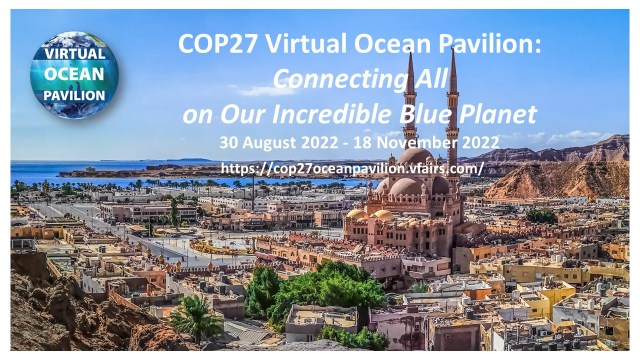
The COP27 Virtual Ocean Pavilionwas held from August 30 until November 18, 2022. The Pavilion opened during Africa Climate Week (August 29-September 2, 2022, see more information below) and covered the duration of the 27th session of the Conference of the Parties to the United Nations Framework Convention on Climate Change (UNFCCC COP27, 6-18 November 2022, see more information below). With the overall coordination by the Global Ocean Forum in close partnership with the Plymouth Marine Laboratory, it was co-organized by the GOF, PML, the Intergovernmental Oceanographic Commission of UNESCO, the Food and Agriculture Organization of the United Nations (FAO), One Ocean Hub, and the Ocean & Climate Platform, together with 28 collaborating partners. The Pavilion drew 4,187 registrations, representing 115 countries, of which 1,313 (31%) logged in to visit the Pavilion and participate in its various features within the duration of the Pavilion and through post-event hosting that allowed on-demand use up to December 18, 2022.
AFRICA CLIMATE WEEK
Africa Climate Week (ACW) 2022 took place from August 29 to September 2 in Gabon, as part of an ongoing series of Regional Climate Weeks on the road to COP27. It was hosted by the Government of Gabon and organized by UN Climate Change in collaboration with global (UN Development Programme, UN Environment Programme and the World Bank Group) and regional (the Africa Union, the Africa Development Bank (AfDB), the UN Economic Commission for Africa (UNECA) and UN Gabon) partners.
ACW 2022 acted as a platform to facilitate collaboration and to explore resilience against climate risks; the transition to a low-emission economy; and partnerships to solve pressing challenges. This is following the recognition of Regional Climate Weeks by the Glasgow Climate Pact agreed at COP26 as a platform for strengthening government and stakeholder response to climate change and continuing the theme of regional collaboration as a driver of global progress that emerged during COP26. Along with the other Regional Climate Weeks, ACW 2022 built on the momentum generated during the virtual events of the 2021 Regional Climate Weeks and will continue to provide a voice for regional stakeholders and promote ambitious solutions for advancing climate action, addressing social inequalities and investing in development that is beneficial to both nature and humanity.
UNFCCC COP27
The UNFCCC COP27 was held in Sharm El-Sheikh, Egypt, at the Sharm El-Sheikh Convention Center with events taking place on 6-18 November 2022. Egypt’s COP27 presidency vision included recognition of the need for global collaboration toward a bold and expeditious response to the ongoing climate crisis, as the window for action is rapidly closing. COP27 planned to build on the successes of COP26 and facilitate future ambition by providing stakeholders with the opportunity to come together and take the collaborative political action necessary to take on the challenge of climate change in a meaningful and impactful way for the benefit of the planet and all of humanity. The goals set for the COP by the COP27 presidency included raising ambition to achieve immediate, united action to mitigate global warming to well below 2C and to work to keep the 1.5C target alive; making the necessary progress under the COP26 Global Goal on Adaptation to enhance global climate change resilience and assist the most vulnerable communities worldwide; and following up on existing commitments and pledges to make significant progress on the pressing issue of climate finance, which is essential to meeting the goals of the Paris Agreement and for meeting the needs of developing countries.
Through the COP27 legacy, Africa aims to highlight the leadership role that it has taken in climate action by showcasing its contributions to the global movement to fight climate change; its commitment to facilitating and mobilizing climate action; and its vision of a just and sustainable future for the people of Africa and the world.
ABOUT THE COP27 VIRTUAL OCEAN PAVILION
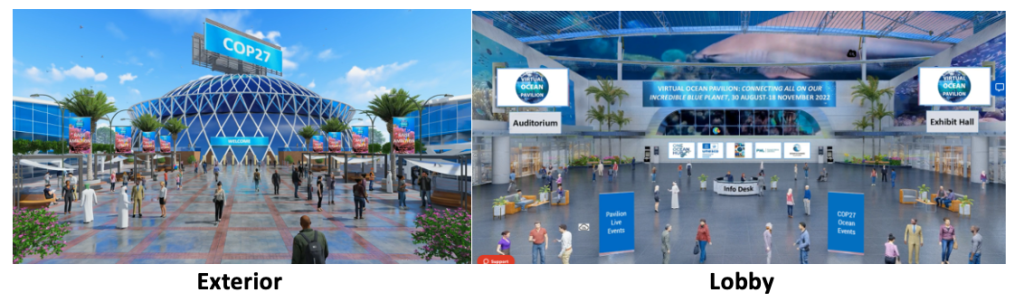
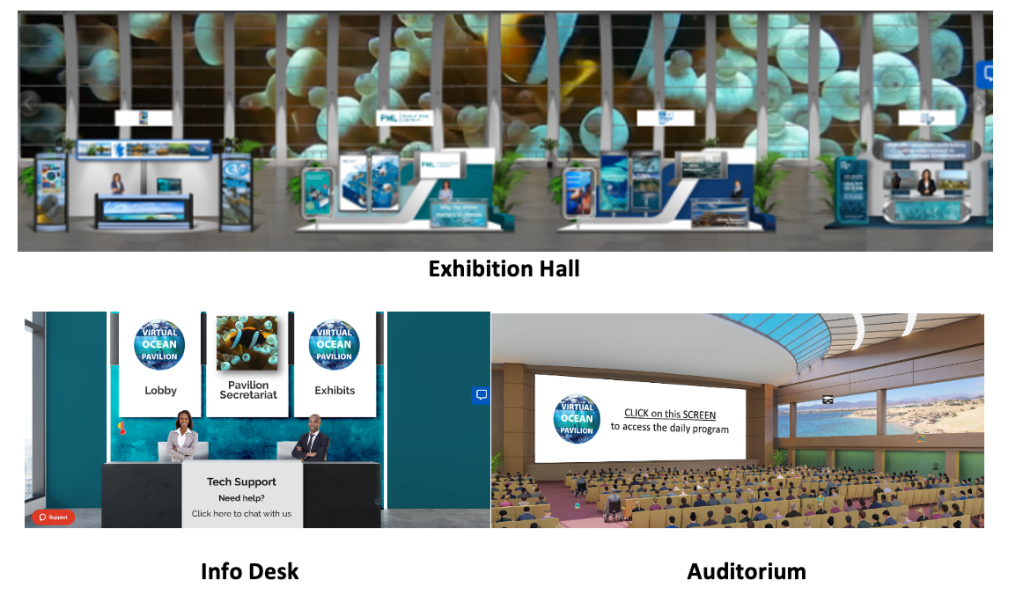
The virtual pavilion environment was designed to mimic a physical event hall with a visually stunning exterior; a lobby featuring dynamic ocean graphics where participants could navigate the platform and access features including the Ocean Events Tracker, photobooth, treasure trove, and info booth, where they could find answers to any questions about navigating the platform and accessing its features; an exhibit hall housing 30 exhibition booths; and an auditorium where visitors could attend webinars in person or view webinar recordings on demand.
The Pavilion aimed to:
Continue to raise the profile of the ocean among members of the ocean and climate community as the Virtual Ocean Pavilion did in COP26;
Provide a communication platform for those who are unable to participate in COP27, and other key ocean and climate conferences, in person from various parts of the world;
Address COP27 priorities while promoting the space for ocean in the climate conference; and
Promote cross-sectoral cooperation and collaboration on ocean-climate action at the national, regional, and global levels.
The Pavilion offered the following features:
Panel sessions linking the ocean with the themes of the Marrakech Partnership for Global Climate Action (MPGCA) and the Subsidiary Body for Scientific and Technological Advice (SBSTA) Ocean and Climate Change Dialogue themes to provide input to these discussions (5 live days and 17 live sessions with Wordly translation into multiple languages);
Thirty (30) exhibits including booths on major ocean-related events in 2022 showcasing national and international initiatives on ocean and climate;
Multiple opportunities for networking and developing synergies among attendees;
Educational and fun features on the platform and in the booths;
A gateway to ocean and climate stories from around the world;
Links to other ocean events at and around the COP.
Providing free registration to access live and on–demand content for the ocean of eventson the road to COP27, the VOP also allowed registrants to explore virtual exhibition booths and link up with experts to learn more about the ocean and climate connection. See below for more details on why registration and attendance was encouraged!
Join live events. Enjoy unique access to Ocean Pavilion and other live events during and in the lead up to COP27 with high level speakers, UN representatives and ocean and climate experts. Wish to branch out? Here you can also find information about joining other live ocean events happening at COP27.
Explore our exhibition booths. Visit 50 ocean exhibition booths without having to walk, sail or swim anywhere! Leading ocean and climate organizations will share their activities and provide access to a wealth of information you can ‘take away’ in your virtual delegate bag – as much or little as you like!
Access on-demand events/videos. Dive in and out of a range of COP27 and other events, interviews and films at your convenience from the end of August through the whole of November.
Discover the Treasure Trove. Explore a collection of ocean music, art, games, climate stories from around the world, plus interviews and events.
Engage with experts. Meet with ocean and climate experts who will answer your questions, share their latest activities on ocean issues, and who would love to hear about your ocean interests.
Watch interviews. Fancy a deeper dive into COP27? Choose from a selection of interviews with Party negotiators and key stakeholders and gain a better insight on COP27, the discussion process and status.
PAVILION HIGHLIGHTS
Webinars
Seventeen live events were organized and conducted in the lead up to and during COP27 as part of the Pavilion’s program of live events: 2 were held on August 30 during Africa Climate Week; 4 were held on November 9 on Finance and Public Education; 3 were held on November 10 on Science, Youth and Future Generations, and Resilience; 4 were held on November 14 on Aquatic Food; and 4 were held on November 16 on Biodiversity, Oceans and Coastal Zones – Mitigation and Adaptation. The live events featured eminent high-level speakers from national and regional organizations, UN representatives, ocean and climate experts and practitioners, and youth leaders from around the world. To watch recordings of these events, visit the Global Ocean Forum’s YouTube channel.
Africa Climate Week Webinars
On August 30, 2022, the COP27 Virtual Ocean Pavilion Opening Event: Raising Action: An Ocean of Prospects and Opportunities in 2022 and Beyond debuted. The event Ocean and Climate Action: Adaptation and Resilience Practices and Tools Clinic also occurred on this day and these events served the ACW purpose of providing a platform for strengthening government, intergovernmental, and stakeholder response to climate change. They aimed to discuss the prospects and opportunities presented by major ocean events in 2022 and global initiatives of the decade in raising action, ambition, unity, and finance to support innovative and collaborative approaches to mitigate and adapt to the adverse impacts of climate change and for climate-resilient development. These included, inter alia, the One Ocean Summit, the 7th Our Ocean Conference (Palau), the UN Ocean Conference, the UN Decades of Ocean Science and Ecosystem Restoration, the International Year of Artisanal Fisheries and Aquaculture, the Convention and Biological Diversity 15th Conference of the Parties, and the UNFCCC COP27 including key events in the lead up to COP27 such as the SBSTA Ocean and Climate Change Dialogue. The events also aimed to discuss regional climate risks and showcase region-specific ocean and climate solutions. Of particular note was a Special Addressby Ambassador Peter Thomson, UN Secretary-General’s Special Envoy for the Ocean, on the outcomes of the 2022 UN Ocean Conference for the occasion of the Opening Event.
Ambassador Peter Thomson in his Special Address on the outcomes of the 2022 UN Ocean Conference for the COP27Virtual Ocean Pavilion Opening Event: Raising Action: An Ocean of Prospects and Opportunities in 2022 and Beyond.Watch the Special Address here.
Finance and Public EducationWebinars
Four events were held on November 9, including:
Whose Ocean Is It Anyway? Why Ocean Heritage Matters for Climate Change Mitigation;
Seagrass – the new frontier in blue carbon credits;
Harnessing Finance for Addressing Climate-Ocean Change; and
Communicating Ocean Science for Climate Action.
This day included the most-watched event, which was organized by Fauna & Flora International in collaboration with Akdeniz Koruma Dernegi, Blue Ventures, Project Seagrass and titled Seagrass – the new frontier in blue carbon credits? This event brought together an expert panel of scientists and practitioners who are working with seagrass systems across the world. Talks included case studies from Turkey, Kenya, Madagascar and the UK, with each panel member delivering a short talk on their specialist topics and country case study. This was followed by a broader discussion of the lessons learned, likely next research steps, and best practice for this emerging area of work.
Webinars on Science, Youth, Future Generations and Resilience
On November 10, the Virtual Ocean Pavilion hosted Indigenous Peoples, Traditional Knowledge, and Ocean-Climate Action, a panel which practiced the art of listening through the stories and experiences of traditional and Indigenous knowledge holders from Namibia, Madagascar, Ghana, and South Africa. The panel encouraged a short discussion on participants’ main take-aways, reflections, feelings, and thoughts after listening to the stories and interventions, and reflected on how different project methodologies can bridge the gap between traditional knowledge, intangible ocean heritage, and climate action. Also held on this day was a session titled Spotlight on Coastal Areas in Small Island Developing States: From Vulnerability to Resilience, which presented data and key findings of novel studies commissioned by FAO on climate change impacts on marine resources harvested in SIDS and their implications for nutrition and food security, as well as on the distinct coastal conditions and hazards, and relevant areas for adaptation interventions in SIDS. A panel of experts also discussed responses and opportunities to address climate vulnerabilities and increase resilience of aquatic food production along the coastlines of SIDS. The final session of the day was titled Youth Meaningful Engagement in Ocean-Climate Negotiations and Expectations for COP27, hosted by the Youth4Ocean Forum and Youth and Environment Europe (YEE). In this youth-led discussion, young ocean-climate advocates and experts shared expectations, priorities, and goals for ocean-related issues to be discussed during the COP27 negotiations, and presented a vision of what meaningful engagement means to them in the context of ocean-climate international decision-making processes.
Live Day on Aquatic Food
On November 14, the Virtual Ocean Pavilion hosted a live day on Aquatic Food, organized by the FAO, One Ocean Hub, and European Bureau for Conservation and Development (EBCD) in collaboration with other partners. It was the first time that a day was dedicated to aquatic food during a climate conference. The overall purpose of the day was to celebrate and to accelerate climate action coming out of aquatic food systems. The day featured messaging on how aquatic food systems are at the core of climate solutions and that blue transformation and climate transition can multiply their contribution to achieving the Paris Agreement goals while protecting human rights, reducing poverty, and ensuring food security.
Events on this day included:
A Blue Transformation to Achieve Paris Agreement Goals;
Fostering cooperation among relevant UN bodies to advance small-scale fishers’ human rights in the face of climate change;
Addressing the Nexus of Climate Change, Poverty, Fisheries Livelihoods and Well-Being – Integrated approaches in the context of Small Island Developing States (SIDS); and
Towards Net-Zero in the Aquatic Food Sector: Decarbonization Pathways for Climate-Neutral Diets.
Biodiversity and Ocean-based Mitigation and Adaptation Webinars
For the final day of webinars hosted on the Virtual Ocean Pavilion, the following events were held:
Ecoship: A Transition Model for the Decarbonization of the Maritime Sector;
Climate Change and Ecosystem Services in Areas Beyond National Jurisdiction;
The Role of Nature-Positive Engineering in a Sustainable Ocean Economy; and
The closing of the Virtual Ocean Pavilion webinar series came with the COP27 Virtual Ocean Pavilion High-Level Closing Event: Raising Unity in Ocean-Climate Action which discussed the collaborative and cooperative approaches that were being used to progress the ocean in the climate, biodiversity and sustainable development agendas considering the outcomes and expectations from the major ocean events of 2022. It included high level interventions, personal experiences and messages across the age spectrum and give examples of collaborative undertakings at the local to global level. The session concluded with reviewing the role and success of the COP27 Virtual Ocean Pavilion in engaging and reaching out to those not able to attend COP27, indeed in its role of democratizing the ocean at COP27 and promoting unity and inclusivity.
For more detailed information about the webinars hosted by the COP27 Virtual Ocean Pavilion, please see the COP27 Virtual Ocean Summary Report.
Exhibit Booths
The Pavilion hosted 30 exhibition booths, which collaborating partners and sponsors used to share their activities and resources on ocean and climate action, highlighting collaborative initiatives at all levels and across sectors. The booths provided access to information that attendees were able to ‘take away’ in their virtual delegate bags. Click on the names of the booths below to access the information displayed during the COP27 Virtual Ocean Pavilion. For more information about the exhibit booths hosted by the COP27 Virtual Ocean Pavilion, please see the COP27 Virtual Ocean Summary Report.
Materials from COP27 Virtual Ocean Pavilion Exhibit Hall Booths
Other Virtual Ocean Pavilion Features
The Pavilion became the gateway to COP27 ocean-related events through the Ocean Events Tracker organized by the Global Ocean Forum and the Plymouth Marine Laboratory in collaboration with Comms Inc. Attendees were invited to register their events through a tracker form. The entries became part of a calendar of COP27 ocean events accessible through the Virtual Ocean Pavilion and based on information gathered through the tracker, by Comms Inc, and by various other organizations that conducted their respective programs of ocean-related events during the COP. There were over 200 unique ocean-related events included in the COP27 compilation. The tracker received a total of 617 clicks from 366 unique users.
In addition, a scavenger hunt (in which 172 visitors participated) and the photo booth (visited 241 times by 161 users) were a draw along with the Treasure Trove(which received 259 clicks from 154 users), which highlighted a collection of presentations, ocean videos, art and photos, ocean and climate stories, reports, and other publications from around the world. Other finds from the Program, Videos, and Resources tabs of the Virtual Ocean Pavilion navigation bar, provided relevant information using a broad range of format to enhance attendees’ experience in their visit to the Pavilion.
CO-ORGANIZERS, COLLABORATING PARTNERS AND SPONSORS
International Alliance to Combat Ocean Acidification
World Ocean Network
Coastal Zone Canada Association
Coral Research and Development Accelerator Platform
Global Fund for Coral Reefs
Ocean Acidification International Coordination Center
The co-organizers are welcoming sponsors as well as additional partners for hosting the Virtual Ocean Pavilion at future UNFCCC COPs. Contacts: Miriam Balgos and Thecla Keizer.
Connecting All on Our Incredible Blue Planet 31 October – 12 November 2021
The first ever Virtual Ocean Pavilion (VOP) at the UNFCCC COP was the product of a coordinated effort among the Global Ocean Forum, Plymouth Marine Laboratory, the Ocean Policy Research Institute of the Sasakawa Peace Foundation, the Oceano Azul Foundation, and the Intergovernmental Oceanographic Commission of UNESCO under the Roadmap to Oceans and Climate Action (ROCA) Initiative, along with 30 collaborating partners. The Pavilion, which was live from October 31 until November 12, 2021, served as a platform for the amplification of the voice of the ocean and for raising the visibility of ocean issues during climate negotiations at COP26. Due to the virtual nature of the Pavilion, which was held fully online, the Pavilion was able to reach a wider audience, including those who were unable to attend the COP in person due to COVID-19. The Pavilion drew 3,000 registrations to attend live events and to view the wealth of on-demand content available in the Pavilion’s Treasure Trove and 26 exhibit booths, which was accessible up to March 12, 2022.
ABOUT THE COP26 VIRTUAL OCEAN PAVILION
The COP26 Virtual Ocean Pavilion had the capability of engaging and reaching those that cannot attend COP26 in person and presented a long-lasting resource for all – leaving no one behind. It also provided a climate-friendly option of participation and so reducing the Pavilion’s carbon footprint.
We built the platform and a diverse group of participants came to deliver what were some of the shining moments of the Pavilion. National and regional leaders led the way, among them:
Mr. Raj Kushaal (Fiji and Ocean Pathway Partnership) spoke during the Opening Event on November 1 about the unquantifiable value of the ocean and its resources to Fiji’s livelihoods and the threat of sea level rise to numerous villages in Fiji that are facing relocation to higher grounds. He emphasized the need for a healthy ocean that no country, regardless of size and wealth, can hope to achieve alone, and that because of the ocean’s interconnectedness, its fate rests collectively in the hands of the world. Citing Fiji’s efforts, he challenged other countries to similarly invest in the protection and management of their oceans.
Ambassador Helen Agren pointed to Sweden’s climate and ocean policies and examples of projects that they support, showing how Sweden provides its share of the solution for the world to meet the 1.5-degree Celsius goal during the Opening Event. She relayed Sweden’s support for continued integration of relevant ocean perspectives in the bodies and work programs under the UNFCCC and the hope that countries will be able to agree on a way to assess progress and share experiences in this endeavor.
The most-watched event in the Pavilion was a webinar on “Ocean & Adaptation, Resilience, and Mitigation” held on November 5, which featured expert presentations on the nexus between ocean and adaptation and resilience, show-casing initiatives around the world on ocean-based solutions, including protecting and restoring marine habitats which are important natural buffers, capacity building, and other cross-cutting approaches.
In his keynote address, Pacific Ocean Commissioner Henry Puna (Secretary General of the Pacific Islands Forum) spoke about three imperatives that we must realize: 1) carbon neutrality, which needs to be achieved within the next three decades; 2) the ambition of the Paris Agreement on climate finance; and 3) the need to deliver on adaptation. He emphasized that the onus is now on us to do what must be done and that together, we can achieve the realization of these imperatives. One of the key initiatives in the Pacific is the establishment of marine protected areas throughout the region. This initiative is consistent with customary conservation practices, a traditional way of life in the Pacific, and would allow them to pass on their heritage to the coming generations.
Representatives of UN and international agencies shed light on the way forward in strengthening cooperation and collaboration among relevant UN bodies in tackling ocean and climate change through current and forthcoming initiatives. In the webinar on this SBSTA Ocean and Climate Change Dialogue theme held on November 1, Vladimir Ryabinin (IOC-UNESCO), Fredrik Haag (IMO), Joanna Post (UNFCCC), Manuel Barange (FAO), and Joseph Appiott (CBD) provided their insight and perspective on their respective organizations’ initiatives in breaking the silos and building partnerships between and among UN agencies.
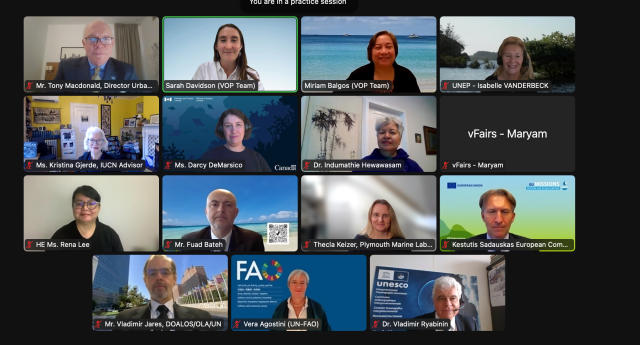
L-R, top-bottom: P. Thomson, UN Secretary-General Special Envoy for the Ocean; E. Maruma Mrema, CBD; V. Ryabinin, IOC-UNESCO; F. Haag, IMO; A. Troisi, IOC-UNESCO; J. Post, UNFCCC; M. Barange, FAO; J. Appiott, CBD; A. Hudson, UNDP; H. Pörtner, IPCC
The climate actions of civil society within the realm of ocean and coastal zones, including those by scientists and experts, administrators, policy analysts, financiers, educators and communication specialists, film makers, a poet and other artists, and the youth were showcased in the Pavilion’s various events, highlighting the important support that they provide in moving the implementation of the Paris Agreement along towards greater action and higher ambition.
In the webinar on the SBSTA Roundtable, the contribution of science through various initiatives which can further the break-up of silos and strengthen partnerships among UN agencies and other stakeholders was illustrated by presentations from scientists Siân Reeves (University of Plymouth), Bernadette Snow (One Ocean Hub), and Lisa Levin (SIO, UC San Diego).
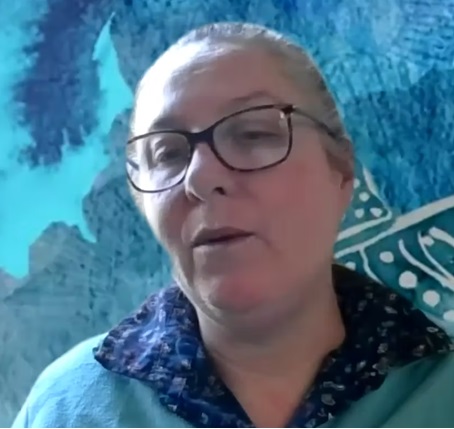
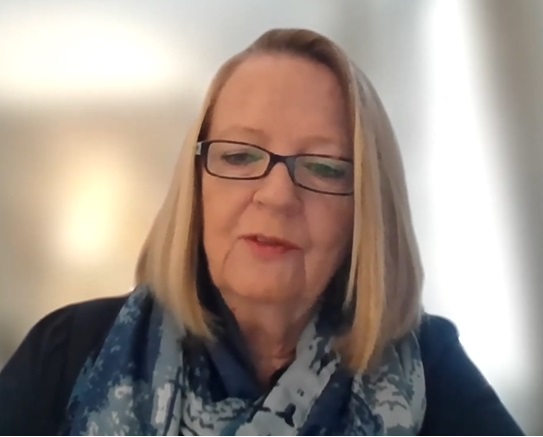
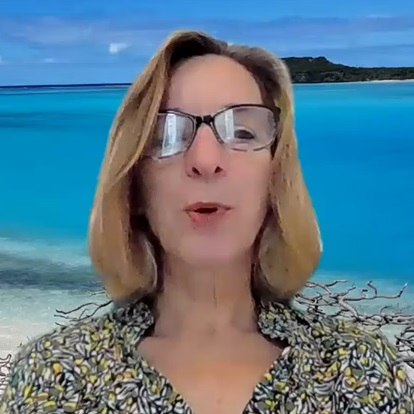
Clockwise from left: Civil society participants in various VOP webinars: D. Herr, IUCN; B. Snow, One Ocean Hub; C. Turley, PML; H. Sakaguchi, OPRI-SPF; Poet S. Jones; S. Goyet, FPA2
A high level event on Ocean & Finance held on November 1 took up a central focus on funding for the protection of coral reefs. In his opening remarks, Ambassador Peter Thomson of Fiji, UN Secretary General Special Envoy for the Ocean, highlighted two major reasons for the involvement of the ocean community in the COP: 1) belief in intergenerational justice and a focus on security for the world’s youth, and 2) to ensure that the ocean has its place at the table in discussions of climate change. Ambassador Thomson stressed the need to push the climate finance needle in the direction of the sustainable blue economy and the protection of the world’s coral reefs, as the blue economy will be what provides security to future generations with coral reefs playing a key role, the extent of which is yet to be determined.
After an introduction of the Global Fund for Coral Reefs, panelists spoke about: the importance of private investors in closing the coral reef finance gap and of breaking down barriers between private and public funding; facilitation of science to inform reef positive solutions; elimination of risk for private investors; and the creation of a blended finance mechanism for the Mesoamerican Reef ecosystem.
The subsequent panel spoke about the role of insurance in providing a safety net for private sector investors in ocean finance initiatives; the need for private sector finance to close the large gap between the ocean-climate funding that is needed; the need to prioritize a larger scale of investment in infrastructure development and implementation of nature-based solutions; the role of government in translating the economic value of the ocean into revenue streams by leveling the playing field, reducing subsidies, and encouraging more sustainable behavior; and a recent study to track international aid projects for ocean conservation and climate action, noting that while the number of projects has been increasing at a steady annual rate, countries have received a small amount of funding for the projects being implemented.
The Vermont law School, in collaboration with SeyCATT, the Youth4Ocean Forum, and the World Ocean Network, organized an event which aimed at demystifying the COP among the youth on November 1. Heidi Johnson, a law student from the Vermont Law School, hosted the “Meet the Blue Expert” event which featured Angelique Pouponneau, CEO of SeyCATT, a non-profit which provides financial support for education, capacity building, and blue economy in Seychelles. Angelique talked about her educational background, her career at SeyCATT, her work on the ocean-climate nexus, and her involvement in the COP as a negotiator.
H. Johnson, Vermont Law School; A. Pouponneau, SeyCATT
The youth were unequivocal on the imperative that net zero must be achieved for them and the next generations to survive. Dr. Jack Laverick, a marine biologist at the University of Strathclyde and member of the Youth4Ocean Forum, reflected on his childhood and impending parenthood, what the world would be like for his son three decades from now if we don’t go harder and faster on climate issues, and his young person’s sense of ambition during a November 4 COP26 side event on coordination and collaboration for ocean-based mitigation and adaptation.
On November 12, in a webinar recapping their experience at COP26, 10 young people from the Youth4Ocean Forum shared their expectations of the COP, what impressed them most, and what they would do with the experience they gained.
Maëlle Montier, a marine science educator at Nausicaa Marine Science Centre, event moderator and panelist, provided an introduction of the Youth4Ocean Forum, a free platform for young ocean change makers between 16 and 30 years old, and the event, which aimed to showcase how action-driven young people can help stakeholders adapt to the climate-induced challenges placed on the ocean and thus improve sustainable development, limiting warming to 1.5 °C, and helping achieve Net Zero.
Kelsey Archer Barnhill, a PhD student from the University of Edinburgh, led the line-up of enthusiastic panelists, full of passion and ideas on how to be an “Ocean-Climate Advocate”.
A. FriedrichA. Datchoua TirvaudeyA. MarinoJ. LuceroJ. TanakaM. RoudautO. GarciaR. DanielOther panelists of the webinar on “How to be an Ocean-Climate Advocate”
Kelsey also articulated her views during a roundtable session on the final day of the COP on “Children and young people’s human rights to a healthy ocean” organized by the One Ocean Hub. A panel of youth speakers and experts discussed a variety of important topics related to the rights of children and young people to a healthy ocean, which included: the ocean-climate-human rights nexus and the issue of intergenerational justice; the power of youth voices in climate conversations; the youth-led, stakeholder-driven Global New Blue Deal; what has been done at a global level to promote the human right to a healthy environment, including the rights of children; youth perspectives on the ocean and intergenerational rights to a healthy ocean environment and the feelings of youth regarding the current climate crisis; and the importance of creating better stewards through introduction of the youth to the ocean through storytelling and the dissemination of science, especially those that have not had the opportunity to engage in direct contact with the ocean. The session called to adults to ensure that the voices of children and youth are central to the decision-making process on ocean protection and the necessity of prioritizing support of children’s participation rights in ocean decision-making.
During the November 12 Closing Event on “Working Together For Our Incredible Blue Planet,” Elizabeth Maruma Mrema, Executive Secretary, Convention on Biological Diversity Secretariat congratulated all those who have made the Virtual Ocean Pavilion possible. She stated that “platforms such as this are critical to ensuring that the voice of the ocean is not lost in these climate negotiations.”
Prior to declaring the Pavilion closed, Ariel Hernán Troisi, Chair, Intergovernmental Oceanographic Commission of UNESCO stated: “For a long time, we have used information technology, virtual means, to communicate…but this pandemic has immersed us into further use of these platforms. So now, at this UNFCCC COP26 meeting, this Virtual Ocean Pavilion has been a huge step forward. ….. This connection to our incredible blue planet, this Pavilion, allowed us to discuss sustainable ocean economies, strengthen cooperation and collaboration needed in particular among UN bodies in tackling ocean climate change, creating, implementing, and enabling framework and conditions for action through science, through capacity development and transfer of marine technology, through cross-cutting approaches with the voice of professionals and youth chats on how to become an ocean-climate advocate, working all together for this incredible blue planet.”
LIVE EVENTS
Eight live events were conducted during COP26 under the Pavilion, which featured eminent high level speakers from national and regional organizations, UN and IPCC representatives, ocean and climate experts, and youth leaders from around the world. The events, which were conducted as webinars, addressed science, finance, partnership and capacity building, public education, collaboration and coordination with a focus on strengthening ocean and climate action as well as securing a place for the ocean in the climate negotiations.
Roundtable on the UNFCCC Subsidiary Body for Scientific and Technological Advice (SBSTA) Ocean & Climate Change Dialogue Theme: Strengthening Cooperation and Collaboration Among Relevant UN Bodies in Tackling Ocean and Climate Change. View.
Ocean & Adaptation, Resilience, and Mitigation: Creating and Implementing the Enabling Conditions for Action Through Science, Capacity Building, and Other Cross-Cutting Approaches. View.
Recap of Youth Chat on the Virtual Ocean Pavilion Key Messages: How to be an Ocean-Climate Advocate?View.
Children and Young People’s Human Rights to a Healthy Ocean: Their Importance for Climate Change Adaptation & Mitigation. View.
COP26 Virtual Ocean Pavilion Closing Event: Working Together for Our Incredible Blue Planet. View.
COP26 OCEAN EVENTS
The Pavilion became the gateway to COP26 ocean-related events through the Ocean Events Tracker organized by the Ocean Conservancy. Attendees were invited to register their events through a Tracker Smartsheet Form. The entries became part of a calendar of COP26 ocean events accessible through the Virtual Ocean Pavilion and based on information gathered through the Tracker. There were 133 unique ocean-related events registered through the tracker.
The 26 exhibition booths, a main attraction of the Pavilion which garnered over 5,000 total visits, were used by collaborating partners and sponsors to showcase their activities and resources on ocean and climate action. The booths provided access to information that attendees were able ‘take away’ in their virtual delegate bags as well as venues for informal meetings with experts and networking among exhibit hosts and attendees.
KEY MESSAGES, INTERVIEWS, TREASURE TROVE, SCAVENGER HUNT, AND PHOTO BOOTH
In addition to information resources provided through the booths, a collection of interviews and informational videos, ocean art, and climate stories from around the world were featured in the Treasure Trove, which contained key messages for the attendees to take away from the Pavilion.
A Scavenger Hunt allowed the attendees to test their ocean knowledge while exploring the COP26 Virtual Ocean Pavilion at the same time. A marine-themed photo booth added a fun attraction to the Pavilion.
Coordinated by the Global Ocean Forum, Plymouth Marine Laboratory, Ocean Policy Research Institute (OPRI) of the Sasakawa Peace Foundation, the Oceano Azul Foundation, and the Intergovernmental Oceanographic Commission (IOC) of UNESCO under the Roadmap to Oceans and Climate Action (ROCA) Initiative, in collaboration with many other partners from across the globe.
OPPORTUNITY FOR FURTHER COLLABORATION: COP27 VIRTUAL OCEAN PAVILION
To help realize the ocean and climate change agenda through the Virtual Ocean Pavilion at COP27, the co-organizers are welcoming sponsors as well as additional partners. The design of the COP27 Virtual Ocean Pavilion will take into consideration the cascade of ocean and ocean-related events in 2022, the COP27 priorities, as well as the lessons learned in the development of the platform and feedback received from the survey of COP26 Pavilion attendees.
Contacts
Miriam Balgos, Global Ocean Forum (mbalgos@globaloceanforum.com) Carol Turley and Thecla Keizer, Plymouth Marine Laboratory (ct@pml.ac.uk; tke@pml.ac.uk) Miko Maekawa, Ocean Policy Research Institute of the Sasakawa Peace Foundation (maekawa@spf.or.jp) Sam Collins, Oceano Azul Foundation (scollins@oceanoazulfoundation.org) Kirsten Isensee, IOC-UNESCO (k.isensee@unesco.org)































 Roadmap to Oceans and Climate Action (ROCA) Initiative